BACK TO HOMEPAGE >
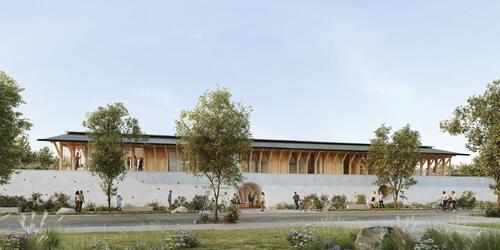
Ziegelwasser Social and Cultural Center | Alsace, France | 2023
Category: Community Centers
Architect: Pascal Philbert, France
Architecture Office: Al Pepe architects
Lead Architect: Pascal Philbert & Aude Lecinski
Design Team: Serue Ingenierie / Catherine Linder
Client: SPL 2 Rives
Photographer: Galerie Blanche
The project examines a deprived neighbourhood of Strasbourg, where the creation of a new social and cultural centre represents a major landmark and a highly important and long-awaited facility for the local community. But, the competition brief apprehends this complicated social context as a threat and requires huge security devices to protect the building: fences, window grids, steel gates and shutters…
Rather than proposing a transparent and open project to then barricade it with anxiety-inducing elements, the project invites the neighbourhood directly at its heart and addresses the security issues differently. The program is implanted behind a massive enclosure wall. A wall that shelters, protects, envelops... but it’s also and above all a dreamlike device, almost magical, stirring curiosity to know what it hides… by perceiving only fragments: the vegetation of the gardens that emerges from it, the sounds, the laughter that resonate there...
This continuous base of the project allows, on the southern side, to extend the horizontality of the beautiful historical ensemble of the old military barracks to complete its urban composition. On the northern side, the alignment thus created offers a presence, a boundary to the street and avoids adding another isolated object to these distended urban spaces.
A wide alley crossing the building from south to north, whose vaulted shape clearly and iconically marks the access to the building, is an invitation to literally bring life and the inhabitants of the neighborhood into the program until the heart of the project, the vast central courtyard.
The space of first reception, in the center of the device, takes the form of a winter garden, making a thermal buffer on the coldest days, but can also fully open onto the courtyard and the street when the temperature allows it. A very large majority of the program is organized on one level around the vast central patio, promoting views and the contribution of natural light, but especially a great legibility of spaces in terms of orientation.
The main activity rooms of the various services do not open onto the patio since they benefit from dedicated, cool and shaded gardens at the east and west ends of the building, allowing an extension of the outdoor use space.
The children’s service is placed on the floor, both to avoid causing nuisance for other services, but also to create a universe apart, a place between heaven and earth for children. The rooms open widely on the planted roofs, but also on the playground, taking the form of a large, bright terrace, airy offering perspectives of freedom and well-being to children.
This project promotes the use of local and natural materials. Lime plaster from Dahlenheim, sandstone from the Vosges, wood from the Vosges forests, glass pavements from Haute-Saône, raw earth coating from Hochfelden... Part of the materials used will also come from reuse: brick paving, crushed bricks in the central courtyard (production waste), …