BACK TO HOMEPAGE >
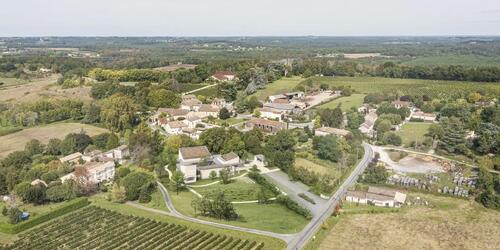
Michel de Montaigne Museum | Gironde, France | 2025
Category: Museums and Cultural Buildings
Architect: Baptiste Manet, France
Architecture Office: Sapiens architects
Design Team: Yann Legouis, Victor Panfili,
Client: Communauté de Communes Castillon-Pujols
Photographer: Sapiens
The project examines Saint-Michel-de-Montaigne, located on the border between Périgord and Gironde, at the top of the hills overlooking the Lidoire valley. It is a village like many others, clinging to the hillside, with a handful of houses scattered among the vineyards. And yet, something else pulsates here, an invisible presence, that of the man who scrutinized the human soul with disarming lucidity. The castle, an imposing vestige dominating the village, still bears witness to Montaigne's passage.
It was there, in the round tower, that he meditated on the human condition and the vanity of our certainties. And today, at the foot of that same hillside, a new place will rise, a space dedicated to his thinking: an interpretation center.
The architecture of the center enters into conversation with its site. It is formally inspired by the village typology and local architecture: built around a courtyard, like rural hamlets, in concrete reminiscent of limestone and canal tile roofs.
A gallery, named Montaigne, connects the various programs and creates an enclosed space, evoking the image of a castle. It forms a loop, offering views of the landscape and the inner courtyard, the heart of the project, which is a multipurpose space that can host various events.
This courtyard is inspired by both the hamlet and the castle, offering an open and bright space. The project is based on Montaigne's thinking, particularly his exploration of the relationship between the “Self” and the “World.” The inner courtyard symbolizes the “Self,” while the views of the surrounding landscape represent the “World.”
The Montaigne gallery connects these two worlds. It is a place of passage, but also a place to linger, where one can stop, observe, read, and let one's mind wander with one's thoughts.
And so, through a subtle play of correspondences, the interpretation center becomes a mirror of Montaigne's work.