BACK TO HOMEPAGE >
Portland International Airport Main Terminal Expansion | Portland, Oregon, USA | 2024
Architects: ZGF Architects
Design Team: Sharron van der Meulen and Gene Sandoval
General Contractor: Hoffman Skanska Joint Venture
Client: Port of Portland
Photographers: Ema Peter, Dror Baldinger
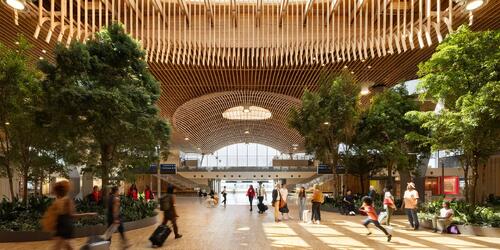
Designed to evoke the feeling of a walk in the forest, the new main terminal at Portland International Airport (PDX) transcends functionality and aspires to create a familiar local feeling reminiscent of the natural beauty and awe of Oregon’s landscape.
The PDX NEXT terminal expansion began as the Port of Portland’s program to accommodate substantial passenger growth, seismic resiliency, reduce embodied and operational carbon, increase economic equity and create a Pacific Northwest inspired architecture that captures the Oregonian spirit. PDX had a clear mission and approached the project with a distinct vision: keep the terminal operational during construction, lead in sustainability, create flexible and adaptable solutions for future proofing airport’s ever evolving operations, enhance the passenger experience, provide clarity of navigation and most of all, keep the local vibe that connects PDX with the community. A unique roof structure, prefabricated on site with all systems integrated in modular cassettes, was transported across the airfield and strategically launched after hours over the existing infrastructure, allowing the new terminal to remain fully operational during construction.
The undulating 9-acre mass timber hybrid roof celebrates the history and future of Oregon’s forest product industry with innovative wood solutions that are locally and sustainably sourced from landowners and mills within the Cascadia region. Biophilic and daylighting design principles were applied throughout along with robust landscaping and natural materials. Portland’s urban planning of small walkable city blocks and vibrant neighborhood scale inspired the design of the terminal as a flexible series of rooms that cultivate a calming atmosphere for both passengers and employees.
PDX built upon Oregon’s history of forest product innovation with a sustainable forest to frame wood sourcing strategy by partnering with landowners, small family forests, community forests, tribal nations and mills within a 300-mile radius of the airport. PDX leadership and the design team toured select regional forests to better understand the unique sustainable and resilient forestry practices. Through this process, the team was able to drive economic inclusivity and equity to rural communities that value multi-generational stewardship of the forest environment.
Sustainable sourcing criteria involved FSC certified wood or innovative transparency-based procurement methods to intentionally source wood from ecological forestry practices above and beyond local regulations. 1 million board feet can be traced back to forest of origin, reconnecting the airport construction back to the land and communities from which they grew.
A healthy environment supporting well-being was a priority for the 35 million passengers forecasted to use the new terminal over the next 20 years. The passenger journey begins with a “walk in the forest” – an interior landscape of over 70 full-grown trees and 5000 understory plants below a series of 49 skylights that allow dappled daylight following the time of day in both sunny and overcast conditions.
Flexible and adaptable infrastructure was required for the new terminal systems to allow for evolving technological and passenger processing innovations. 35 tapered locally fabricated Y columns support a 100’ x 150’ long span structural grid. The modular cassettes are constructed from double steel girders, varying curved glulam beams, a mass plywood vaulted roof deck and a lattice ceiling. Unobstructed floor plates create column-free security checkpoints and adaptable ticketing islands – future proofing roadblocks to check-in, security, passenger flow, processing and retail concessions. Given PDX location within the Cascadia subduction zone, the new terminal was designed to withstand a magnitude 9 seismic event. The 9-acre mass timber hybrid roof, which connects to the Y-columns via seismic isolating discs provides the armature to hang the exterior framed curtainwall.
The PDX terminal builds upon its legacy as a destination airport for the local community. Portland’s MAX Red Line light rail from downtown to the airport was upgraded with a new terminal station to enhance the passenger experience. Additionally, the local brand retail program continues PDX’s outlier status reflected by the ratio of amenities pre vs post security, where PDX has an industry leading 30% concessions pre-security. The design allows anyone to walk through the building to public lounge areas with views of the airfield, and the project contains many publicly accessible gathering spaces that redefine how an airport’s civic architecture and infrastructure can benefit a community.