BACK TO HOMEPAGE >
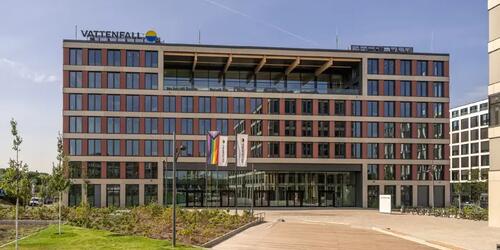
EDGE Suedkreuz Berlin, Berlin, Germany | 2022
Architects: Tchoban Voss Architects BDA
Lead Architect: Sergei Tchoban
Client: EDGE / SXB S.à r.l.
Photographers: Ilya Ivanov and Michael Fahrig
Project Partners: Stephan Lohre and Karsten Waldschmidt
Design Team: Julia Angelstorf, Lev Chestakov, Giorgia Fontana, Ulrike Graefenhain, René Hoch, Anastasia Kapustina, Valeria Kashirina, Birgit Koeder, Achim Linde, Fabiana Pedretti, Dennis Petricic, Manuela Peth, Soeren van Ost, Fabio Prada, Anja Schroth, Katharina Stranz, and Carolin Trahorsch
Collaborating Architects: granz + zecher architekten GmbH
Landscape Architects Stages 1-4: hochC Landschaftsarchitektur
Landscape Architects Stage 5: granz + zecher architekten GmbH
General Contractors: ARGE SXB, Suedkreuz Berlin ZECH Bau GmbH, CREE Deutschland GmbH, Rhomberg Systemholzbau GmbH represented by ZECH Bau GmbH, Berlin
EDGE Suedkreuz Berlin is a seven-story office complex consisting of two buildings with a total floor area of approximately 32,000 square meters. The complex stands on an approximately 10,100 square-meter site and has been built using sustainable, climate- and resource-saving, and modular hybrid-timber construction techniques.
The larger of the two freestanding buildings contains approximately 20,000 square meters of floor space. This makes it – for some time to come – the largest freestanding hybrid-timber building in Germany and one of the largest in Europe. From May 2022 it will be the new German headquarters of the energy supplier Vattenfall Germany. The new office complex is part of a new urban district. Its planning involved restructuring the area between Sachsendamm, Hedwig-Dohm-Strasse, Hildegard-Knef-Platz, and Lotte-Laserstein-Strasse. The smaller of the two buildings (the ‘Solitaire’) is an elongated freestanding building that continues the line of the façade of the larger office building. The latter is a quadrangle-type structure (the ‘Carré’) with an irregular trapezoidal footprint. The two buildings form a street front facing Hedwig-Dohm-Strasse. In the direction of Südkreuz Station, they create a new urban plaza with green spaces and seating. The heart of the Carré building is a spacious, light-filled atrium.
A two-story entrance lobby with a clear height of seven meters facing the plaza in front of the building opens up the massive, strictly gridded volume and directs the gaze firmly towards the building’s impressive interior. The 26-meter-high atrium is covered by a transparent ETFE foil roof carried by a wooden-truss construction. The continuous floor-to-ceiling windows in the offices, the glazed entrance area, and the large panoramic window in the building’s lounge additionally contribute to the abundance of daylight. A central highlight is the four treelike shapes of different heights which grow skywards under the foil roof as if in a greenhouse.
Their lamellate spruce-wood structure gives them a resemblance to gigantic mushrooms. At ground level, green islands of tranquillity group themselves around their stems. The atrium is additionally enlivened by community and food areas. The crowns of the so-called ‘Trees’ carry platforms for recreation; these form green leisure and communication zones at various heights. In every part of the building – from the supports, beams, windows, and doors to the claddings and railings – wood is visible in all the interior areas, adding an enriching liveliness to the complex’s clear architecture and bringing nature into the individual spaces. The building is an open ecological system. The clear symbolic focus of its architecture is the forest: the origin of wood, the material which defines this building’s character. Each of the building’s inner corners contains a building core with a safety staircase and elevators. Parts of the roof are extensively landscaped. The ‘Solitaire’ building The Solitaire building has a two-story entrance lobby with a clear height of seven meters. Floors two to seven contain offices. The ground floor houses gastronomic, commercial, and retail spaces. Here wood is also a ubiquitous architectural and design element.
The building is entered from the new urban plaza. Vertical access is provided by a central core with a safety staircase and two elevators. The landscaped outside space of the lounge on the building’s roof has a garden-like quality. Both the Carré and the Solitaire buildings have a flexible modular ground plan on all levels. Biomethane cogeneration plants ensure efficient heating. The façades have a regular grid consisting of sustainable and weather-resistant glass-fiber concrete panels. The grid is articulated by horizontal strips and colored vertical panels. Pylons structure the façades vertically. Glass-fiber pilasters visually reinforce the socle section. The rhythmic façades have a restrained color scheme which has been chosen individually for each of the two buildings. Two different shades were selected for each façade. The natural material wood is everywhere in the interior and office spaces and makes an important contribution to a lasting healthy indoor climate for users. Wood possesses a high heat-storage capacity but limited thermal conductivity. Existing heat is retained for longer in the room than heat from other construction materials. The delayed cooling reduces the amount of energy required. Wood is also lighter and more energy-efficient to transport than mineral construction materials.
This project used approximately 3500 cbm of FSC-certified spruce – a total of approximately 1300 trees. Through the intelligent combination of wood with concrete, the modular hybrid solution from CREE-Buildings can save up to 80 percent CO2 per sqm of floor area: Ideally, only about 0.15 t CO2 per square meter is emitted instead of about 0.75 t CO2 per sqm with conventional construction methods. Low construction weight, short shell construction times, high reliability in planning and costs, and long durability are other advantages of this construction method. The construction materials used in EDGE Suedkreuz Berlin are extensively recyclable using the principle of cradle-to-cradle recycling. Reinforced-concrete construction elements were kept to a minimum, being used for fire compartment separation or to stiffen the building. The design of the components responds directly to the strengths and qualities of the respective materials and promotes the saving of the resources used and reduces the weight of the components. The roof structure weighs only 45 kg per sqm due to the specially developed metal nodes, the ETFE foil as well as the filigree wooden components, and ensures greater lighting in the atrium below thanks to narrower cross-sections.