BACK TO HOMEPAGE >
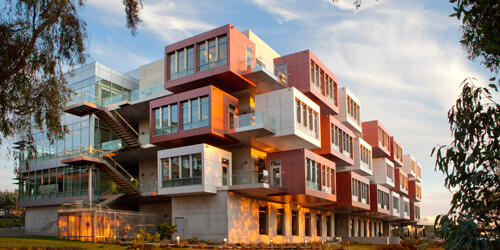
Sanford Consortium for Regenerative Medicine | La Jolla, California | 2012
Architects: Fentress Architects
Associate Architect: David Davis Architects
Client: Sanford Consortium for Regenerative Medicine
Contractor: Hensel Phelps Construction Co.
Photographers: Jason A. Knowles © Fentress Architects © Steve Keating
Located adjacent to the Salk Institute, the vision for the Consortium is to catalyze collaboration by building and operating a new stem cell research facility specifically designed for productive, multi-disciplinary scientific collaborations that ultimately enable scientists from the University of California San Diego (UCSD), Salk Institute for Biological Studies, Sanford-Burnham Medical Research Institute, La Jolla Institute for Allergy & Immunology, The Scripps Research Institute, and other research organizations to work side by side on harnessing the regenerative power of stem cells to diagnose, treat, and one day cure degenerative diseases and injuries.
With that challenge in mind, the studio studied the assumptions of laboratory design, typically a box-shaped module, and questioned how to build upon this standardized model in order to promote creative interaction.
To form this “Collaboratory,” the designers shifted the standard lab module placement in opposing directions, from north to south and east to west, and created open “research neighborhoods” separated by common-use breakrooms. This circulatory design shift increases the opportunity for impromptu meet-ups and dialogue, pulls researchers out of their routines, and encourages interaction. Breakrooms are two stories and connect adjacent research levels with open stairs.
Each of the four levels includes conventional formal conference rooms and open, touch-down spaces with a more informal, lounge-like atmosphere. All conference, lounge, and breakroom spaces are equipped with write-on walls and interactive communication technology. Glass walls are used extensively throughout the interior to invite participation and awareness, both inward and outward.
These design strategies are developed as areas of “creative collision” where people and ideas intersect. The most identifiable image of this building includes the private office “pods” reserved for the most senior researchers at the Consortium. Cantilevered from exterior walkways, the pods offer protected views that overlook the Pacific Ocean which further intensifies an atmosphere of contemplation and communication. The Consortium also includes a café with indoor/outdoor seating, a 150-seat auditorium, and a semi-private elevated terrace, all separated from the main lab building.
A pedestrian bridge connects the Consortium to the UCSD campus across the street. The Consortium was also designed as a case study in highly-efficient laboratory design by integrating environmentally-friendly concepts into the project’s very aesthetic. Generous daylighting, shading devices, use of native plants and adaptive species, and displacement ventilation are among the strategies used to achieve USGBC’s LEED Gold certification.
The Architect’s design emphasizes the concept of collaboration, where interaction between researchers is encouraged through the artful placement of spaces. The studio’s emphasis on open interiors, sustainable practices, and flexibility is grounded in the belief that architecture can invite and promote breakthroughs in thought and achievement.
Today, the Consortium serves as an example, not merely across the nation, but around the world, that design is about more than aesthetics. Executed thoughtfully and correctly, design excellence can improve research taking place within the laboratory by imbuing activities with the sense of importance they deserve and foster a spirit of collaboration.