BACK TO HOMEPAGE >
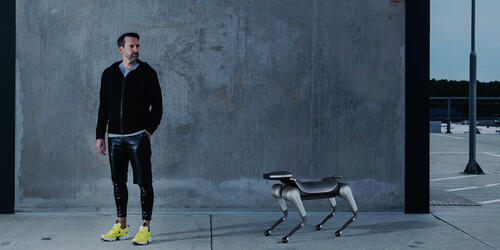
Koda Robot Dog | 2020
Designers: Akifusa Nakazawa, Wei Gu, Dan Harden, and Sungbum Park, Whipsaw, Inc., San Jose, California,USA and Li Xuesheng, Delu Dynamics Technology Co., Ltd., Chengdu, China
Manufacturer: Delu Dynamics Technology Co., Ltd., Chengdu, China
KODA is an advanced robot dog used as a family companion, a seeing-eye dog, or a guard dog to patrol a property. It has four 3-dimensional surround-view cameras and 14 motors, including the neck and tail, which gives it dog-like gestural qualities.
It can run two meters a second, climb stairs, and respond to and learn from every environmental condition due to its advanced A.I. machine-learning and internal 11 teraflop processor.
Each KODA is connected to a blockchain network used to share and optimize data among the pack, so every KODA robot gets smarter over time.
KODA’s A.I. allows it to respond to its owner’s voice commands and emotional state, whether sad, happy or excited. Its design demonstrates a good balance between a friendly Labrador and a slightly intimidating Doberman to fit its many purposes.
Design Innovation
KODA is the world’s first consumer-based dog robot, and it’s loaded with innovation.
The Problem: Facility security requires mobility, smarts, technology, and consistency, beyond what a dog can provide. Seeing dogs require sleep, food, and play—sometimes at critical times when you need them.
Robot technology is evolving but needs a more feasible four-legged platform to advance.
KODA’s core innovation is that it assists the human condition.
It can monitor and protect properties; help disabled people see and navigate safely; play with and teach kids; and serves as a tech learning platform for robotic research
KODA’s body is like a dog, but it is uniquely designed around its robotic needs. (i.e., the leg geometry and degrees of freedom are designed for it to run, walk, sit down, and lay down.) It can walk anywhere, including upstairs, or across mud and gravel.
KODA’s blockchain-enabled decentralized A.I. allows it to “learn.” It incorporates an onboard supercomputer that makes its learning power future-proof in its evolution and application.
Its head contains an array of sensors and cameras organized along the head beltline. It’s waterproof, so surfaces are rounded to expel rainwater or snow.
To recharge, it walks over the charger and lays down on it, bringing its belly in contact with the charge nodes. Its batteries are low in the abdomen to keep the center of gravity as low as possible. Its tail contains rear-facing sensors. It features two hand lift points for lifting into vehicles.
Benefit to User
KODA’s benefit to the user is that it provides assistance to the human condition, which is no easy task. It can monitor and protect properties; help disabled people see and navigate safely; play with and teach kids; and serves as a tech learning platform for individuals, schools, and robotic research institutions.
It can learn far beyond the limitations of geography which benefits the end user. For example, a KODA dog in Phoenix can harness the knowledge of other KODAs in its pack that are based in colder climates, like Anchorage or Toronto.
Without ever having set foot on ice, the KODA in Phoenix will learn how to avoid slipping, including warning its owner.
KODA has been designed to imbue “emotional intelligence” for the benefit of the user. Through the same decentralized network and bevy of onboard sensors, the robot will learn when an owner is sad, depressed, happy, or excited, and behave appropriately in response to those human emotions.
Every design element, including head design, neck movements, body gestures and tail wagging, has been for the benefit of the end user.
KODA isn’t trying to compete with the rewarding aspects of training and bonding with a real dog. For apartment buildings that don’t allow dogs, however, KODA does provide an alternative for some daily comfort and communication.