BACK TO HOMEPAGE >
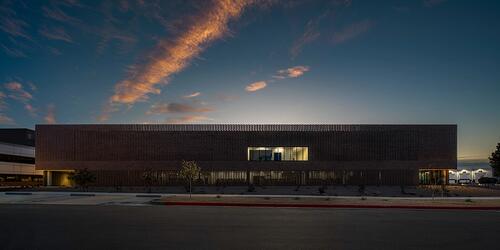
Honorable Mention: American Architecture Awards 2024
Southeast Justice Center | Mesa, Arizona | 2023
Architects: Multistudio, Inc.
General Contractor: Layton Construction
Client: Maricopa County
Photographers: Matt Winquist, Winquist Photography
A democratic society relies on the foundations of justice as much now as ever. However, like wealth and opportunity, justice remains unevenly distributed. Marginalized individuals and communities continue to seek justice that often remains elusive. Architecture, under certain contexts, is perceived as complicit in perpetuating unjust norms, where "ill-formed formality only fossilizes great pain."
Engaging in architectural projects related to the justice system is challenging in this contentious context. It can be argued that increased attention and involvement in justice practices, rather than abandonment, offer a more reliable path towards a more just society. Institutions reflect society, and conversely, society reflects its institutions. Buildings, unlike human sentiment, do not change swiftly. Perhaps buildings need not change rapidly; their permanence can mirror the ever-evolving human experience.
The Southeast Justice Center aims to foster greater social engagement by avoiding deterministic readings. Rather than shaping experiences, it seeks to create space for diverse interpretations. Initially conceived to consolidate, organize, and secure, the project now imagines how it can also become permeable to societal influences. It strives to embody evolving social ideals and insights into equity, not by being transient or generic, but by embracing absence as much as presence.
The architecture of the Southeast Justice Center echoes the language of the Superior Court it complements, yet introduces a softer approach. It incorporates "absent corners," where material is intentionally omitted between corners and enclosures. This porous, light-filled absence, lacking mass but not substance, continually interacts with its surroundings, reimagining static forms in dynamic relationships with ground and sky.
The center's design reflects ideological shifts in justice administration, moving away from intimidation towards restorative practices. Opaque materials give way to garden-like periscopes or roof monitors, revealing directional interests in sunlight behind an exterior brick veil. The pavilion's thinness and acoustic dampening aim to deinstitutionalize and reduce surveillance emphasis, contrasting with the stability of nearby court buildings.
Navigating large interior complexes within the center is clarified by a monumental stair that ascends gradually, varying in steepness to enhance attentiveness with each step. Movement through sunlit spaces provides cues for orientation, connecting inhabitants with natural rhythms. Interior spaces are animated by daylight, painting an ever-changing atmosphere organized by the play of diffuse sunlight.
Courtrooms within the center feature permeable configurations, such as asymmetrical turnstile galleries conducive to high-volume exchanges at the bench. Ceilings and walls suggest order and weightlessness, alleviating the courtroom's societal gravitas. Embracing civic stability and social pluralism, the Southeast Justice Center embodies openness, expressing its process of creation and inviting continued inquiry into the complexities of societal understanding.