BACK TO HOMEPAGE >
Honorable Mention: American Architecture Awards 2024
Pennsylvania State Archives | Harrisburg, Pennsylvania | 2023
Architects: HGA Architects and Engineers
Lead Architect: Paul Neuhaus
Associate Architects: Vitetta Architects & Engineers
Lead Architect: Daniel Vodzak
General Contractor: Mascaro Construction
Client: Pennsylvania State Archives
Photographers: Esto/Albert Vecerka
How long should a piece of paper last? Not any piece of paper, but one on which the events, accounts, or records of the people of the State of Pennsylvania and the nation is written?
That piece of paper could be the Pennsylvania Charter, signed in 1681 by King Charles II of England giving William Penn authority over the then English province. It could be the 1780 legal document describing the passage of the state law calling for the abolition of slavery. The paper could be part of a set of 1915 field reports by suffragist Liliane Stevens Howard, contributing to the eventual passage of the nineteenth amendment in 1920, giving women the right to vote.
And the paper could be the written notes of Harold R. Denton of the Nuclear Power Commission in 1979 – words that would restore confidence and calm to a shaken public after the nation’s worst nuclear accident at Three Mile Island outside of Harrisburg. Those documents are among the over 300 million letters, disquisitions, photographs, maps, and records at the new Pennsylvania State Archives which collects, preserves, and makes them available for research.
This latest iteration of the archives supersedes previous facilities dating back to 1903, relocates the archives from the Capitol Complex to a blighted neighborhood 1 mile north, and forms part of a wider effort to revitalize the central city.
The new 146,000 sq.ft. facility is a leader and top performer for state archives across the country and has space to grow. Whilemost of the building is dedicated to collecting and preserving, documents are available for viewing by the public, either digitally in the Main Reading Room, or directly in the Original Documents Room.
Visitors include individuals researching family ancestry, historians, academic researchers, and the curious. Researchers are provided with tools and amenities for a productive and comfortable stay - computers, scanners and printers, a kitchenette with seating, lockers, meeting room, classroom, gallery, and all-gender restrooms. The classroom and meeting rooms are also reservable for use by community groups.
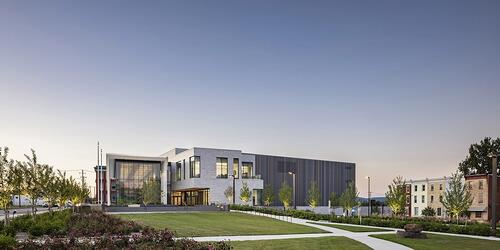
The building design embodies the Archive’s program of collecting, preserving, and public access through an arrangement of three volumes set apart materially and programmatically. The geometry and orientation of the volumes is informed by the street grid which inscribes a near parallelogram bordering the site.
A glossy-glazed brick volume forms the main body of the archives, housing the collection on 4 floors, on 12-foot-tall high density shelving. Five neutral colors of glazed brick were developed with a local brick plant to clad the mostly windowless volume, contributing to a sense of lightness and reflection that at certain times of the day, melds the form with the sky and adjacent landscape.
A tall narrow matchbox form, sheathed in vertical bands of aluminum, appears as a companion to the brick volume, and houses mechanical systems. This side-stack position provides dedicated AHU’s to each floor and ensures liquids can never leak onto the collections. Redundant HVAC systems provide uninterrupted, tightly modulated temperature and humidity levels to each collection environment – paper (temperate), print photography (cool), and film (cold).
The 2-story glass pavilion set in a public garden along 6th St N provides a place for individual and group research with visual openness and accessibility. The full-height glazing, overlayed by a light-modulating sunshade, conveys openness and protection. The visibility offers an invitation to passersby, while the sunshade filters light and acts as a buffer from the busy street.
Anticipating potential impacts of climate change and recognizing vulnerability to human-caused loss or damage, the planning by the design team addresses fifteen potential Achilles heels, including toxic chemical spills from the adjacent railroad yard; extreme or intense precipitation; document theft (both outside and inside jobs); invasive pests; moisture/mold growth; extreme wind; broken/burst plumbing; and city-wide power failure.
How long should a piece of paper last? Forever is a long time, but the art and science of preservation will evolve over time. The people of Pennsylvania value this richly illustrative collection of documents, and with this archive they are making their best bet these resources will be around into perpetuity.