BACK TO HOMEPAGE >
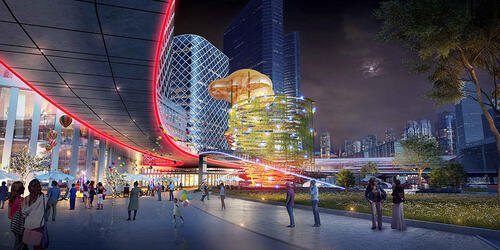
Urban Design-Central District of Guangzhou Eastern Transportation Hub | 2018
Bejing, China
Architects: ISA Internationales Stadtbauatelier, Beijing, China
Client: Guangzhou Municipal Planning and Natural Resources Bureau (Zengcheng District), Guangzhou, Guangdong, China
Photographers: Complements of the architects
The Guangzhou Eastern Transportation Hub is located in the “Eastward Axis” of the Guangzhou Urban Space Development Strategy. In the future, it will become a super transportation hub integrating national railways, interurban railways, urban railways, long-distance coaches, city buses, and taxi services together. Per difficult existing conditions, design solutions are looking for the minimum intervention based on “human oriented” and “public spaces oriented” principles. A U-shaped public space (U Belt) zips the south and the northern sections together on a human scale. By constructing a series of pedestrian-friendly hubs, the design enhances the “image” of the Eastern Transportation Hub, making it stronger, clearer and easier to be caught/recognized by the visitors. The U Belt is 2.5 km long and 80-100m wide, it links together all different core functions and landmarks of the district; it also serves as a covered walkway and ecological corridor connecting different zones/areas. The U Belt makes a simple and strong solution in a complicated context.
The Guangzhou Eastern Transportation Hub is located in the “Eastward Axis” of the Guangzhou Urban Space Development Strategy. In the future, it will become a super transportation hub integrating national railways, interurban railways, urban railways, long-distance coaches, city buses, and taxi services together. The central district of the Eastern Transportation Hub benchmarks against the world class transportation hubs, aims to be a key gateway for passenger transportation in the coastal region of southeastern China. Recently, a lot of new headquarters have settled in this district; however, highly-dense transportation and business capacity also brought enormous traffic pressure. The current challenges are: how to maximize the efficiency while addressing the complex transportation issues? How to guild new developments running hand in hand with the nature environment and good pedestrian/human experiences?...... These all call for design solutions. Per difficult existing conditions, design solutions are looking for the minimum intervention based on “human oriented” and “public spaces oriented” principles. A U-shaped public space (U Belt) zips the south and the north sections together on a human scale. By constructing a series of pedestrian-friendly hubs, the design enhances the “image” of the Eastern Transportation Hub, making it stronger, clearer and easier to be caught/recognized by the visitors. The U Belt is 2.5 km long and 80-100m wide, it links together all different core functions and landmarks of the district, it also serves as a covered walkway and an ecological corridor connecting different zones/areas. The U Belt makes a simple and strong solution in a complicated context. The U Belt can be divided into three different sections with various methodologies in design. The northwest segment in the business headquarter cluster, spaces under the arched interurban railway bridge are used for the Lowline Park, providing recreational spaces. The south segment in the commercial area of station square, U Belt serves- a suspended bridge is introduced to connect the arrival floor with the commercial complex around it. The north segment incorporates the design concept of “scenic city,” in which the central garden and the U Belt make a three-dimensional atrium. The whole U Belt has four tracks for four different speeds: the speed of ADA path, the speed of walking and jogging, the speed of roller skating and other activities, and the speed of mini scooters. Each track is designed according to its characteristics. Different covered sections and branch-corridors keep connecting to the main U Belt which makes a complete pedestrian system for the area. The U Belt also serves as an ecological corridor that connects the large green parks within the region. It is also a “boulevard” with large trees on both sides of the U Belt, which will help in relieving the adverse impact of the railway. The Vessel Plaza in the center of the U Belt serves as a scale-friendly landmark for the region, help to reduce the emotional pressure for people in a super condensed urban environment surrounded by high-rise buildings and traffic pressures. The top of the Vessel is a cloud-shape water storage tank connected with the pipe system for plant irrigation. Vessel’s main body is all covered by vegetation. Viewing platforms/walkways both inside and outside Vessel bring endless views, experiences and fun between urban and natural, realistic and surrealistic world. In a difficult and complex regional transportation hub context, the design solution brings a brand new urban “gateway” in eastern Guangzhou’s landscape, brings a very strong gateway “image,” improves pedestrian experiences, and introduces new smart and ecological design concepts.