BACK TO HOMEPAGE >
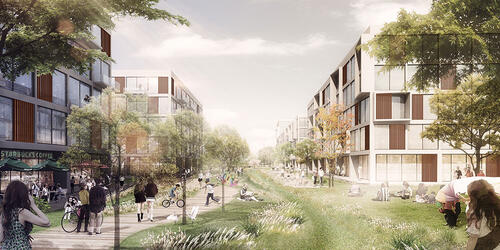
Urban Planning and Design of Academician Valley | 2019
Jinghe New City, Xixian New Area, Xi'an, Shaanxi, China
Designer: ISA Internationales Stadtbauatelier, Beijing, China
Client: Management Committee of Jinghe New Town, Xixian New Area, Xi'an, Shaanxi, China
Located in the north of the City of Xi'an, on the bank of the Jinghe River, 25 km from the center of Xi'an old town. Known as the ancient capital of 13 dynasties in Chinese history, the ancient Silk Road also started with Chang’an (now Xi’an). Today, it becomes the core development area of the “Belt and Road.” And as an important node for Greater Xi'an northern development, it has good ecological condition, rich historical and cultural resources, and strong cultural image and local identification. The two challenging parts of the project are: how to inherit the “old” traditional culture into the “new” sustainable spatial structure; how to bring in new industry economy and protect the original ecosystem in the meanwhile. The proposed development concept and strategy includes the following five segments:
1. Cultural sustainable development – “rites and music”, to reorganize the traditional pattern in new urban texture Derived from ancient Chinese civilization, “rites” stands for the order of heaven and earth, and “music” for the harmony of heaven and earth, together shaping the various landscapes of Chinese city. The Lifang unit system in the capital city of Chang'an (Tang Dynasty), along with the water channels inside the city, fully interpret Chinese traditional philosophy imparted by the rites and music. Starting from building concept of Chang'an city (Tang Dynasty), the traditional pattern has been reorganized to adapt to the smart urban texture in future.
2. Traffic sustainable development – smart transportation model, to create more possibilities for different users Different from conventional isolated spatial model, the design proposes “small block, intensive road network” inside the new city, to provide the walkable open groups and the comfortable environment and accessibility for vehicles around so that promotes street vitality and also lays a foundation for new traffic mode. Shared green smart transportation system is designed for the entire residents in Jinghe New City. The public transportation system as the main means of transportation in the city, includes rail transit, medium transport traffic, BRT, bus trunk road and shared cars. There will be a shared parking center around the subway station within 300 meters, providing services like shared car rental, bus hubs and taxi parking area to reduce car trips. All three cities are well connected by TOD mode, and to combat the heat island effect and avoid traffic jam, urban CBD area is arranged along the international axis responding to the scientific research, industrial and social service.
3. Ecology sustainable development – based on historical hydrological system, to give it a new life There’s the main canal of Zheng Guoqu on the north side of the site, which is an important water world cultural heritage belonging to the “three ancient water conservancy projects” in China. Taking advantage of canal’s own system, a blue-green network formed to play a role in rainwater collection, retention and infiltration as an organism in a sponge city, besides, to help lower the infrastructure investment. Through two levels of “tough water capsule” structure with water collection, storage purification and landscape functions, the stormwater management and regional safety are assured. Before rainwater is flowing into Jinghe River, it goes to green land network firstly and gets purified through the wetland on the bank. A blue-green network has become a ventilation corridor contributing to urban microclimate improvement while providing adequate space for small animals.
4. Economy sustainable development - innovative economic development model, to shape a new growable scientific research city The academician economy is a type of emerging economy more alive in recent years, and there’s no precedent to be learned on how to deal with it as well as possible. By analyzing the site’s development status and evolution of the academician economy, the proposed new development approach includes setting up a compact research unit with the scientific research laboratory, educational exchanges, conference function besides individual living in an Academician's Unit on 200-330m scale. As a basic unit, the courtyard is in a highly flexible organization and possesses enough private or communication space. Three growable research new cities built along the river in turn are centered with Academician's Unit that serves as a motor for the entire city.
5. Architecture sustainable development – “urban living room”, a new landmark for all The urban living room has been a key public node in the design concept. As the interface to the historical city of Xi’an, various ecological technologies, such as rainwater collection and purification, green roof, photovoltaic energy, and microclimate regulation, are applied. Multiple functions are proposed for cultural exchange, casual meetings, conference and exhibitions as well as sports and recreation. The new landmark is supposed to be a lovely place which is featured with an international image, and well welcomed by different kinds of people. During the design process, the team integrates the smart system with water system, green space, transportation, economy, history and humanities seeking the complete symbiosis of city, nature and human.