BACK TO HOMEPAGE >
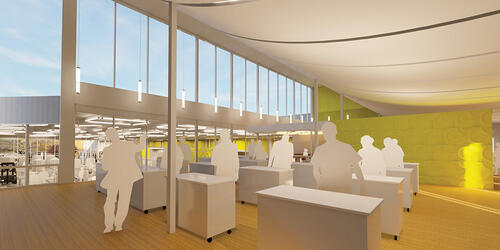
Wahiawa Value-Added Agricultural Product Development Center | 2018-2021
Honolulu, Hawaii, United States
Architects: UA Community Design Center + UA Resiliency Center + Urban Works Architecture, Fayetteville, Arkansas, United States
Design Team: Stephen Luoni, Steven L. Anderson, Claude M. Terral III, and Garrett Grelle
Client: Hawaii Department of Agriculture, Agribusiness Development Corporation, Honolulu, Hawaii, United States
Photographers: University of Arkansas Community Design Center
The project repurposes a 33,000-square foot metal warehouse into a Value-Added Agricultural Product Development Center (VAC) in downtown Wahiawa. The VAC is a food innovation makerspace for college students anchoring a proposed island-wide network of cooperative food production facilities under development by the State of Hawaii Department of Agriculture. Despite being the world’s most remote occupied landmass, the State’s goal is to build a local food economy since 95 percent of Hawaii’s food is imported. The VAC will support a new food science design curriculum towards incubation and commercialization of value-added food products through the recycling of nearby agricultural waste streams—one of a few such programs nationwide. Resiliency for Hawaiians is tied to the future of food, energy, and housing. Adaptive reuse of the warehouse addresses the problems of a downtown windowless big box. Courtyards are strategically carved from the closed-plan/closed-section facility to create new public spaces and building entrances accompanied by roof monitors for illuminating interior spaces. The design re-organizes the facility as a series of three ‘lofts’ adaptive to changing production processes for baking, fermentation/pickling/dry goods production, juicing, distillation, food-grade cosmetics, and packaging. A Public Loft fronts California Avenue for visitor events and product sales; a Production Loft accommodates product design, processing, and packaging; and an Administration Loft on the mezzanine level houses classrooms, conference space, and an office area. Lofts are flexible, privileging changing production futures over an efficiency that services a fixed present.
The facility must comply with the new U.S. Food Safety Modernization Act (FSMA) regulations, a preemptive set of science-based protocols to prevent food contamination. FSMA elevates hazard analysis and preventive control throughout all production processes from farm to table, supported by health and safety controls in facility design and operations. Facility construction should be smooth with minimal articulation and joinery to prevent water and pest intrusions; resist mold, mildew and bacterial growth; and, clad with an exterior skin resistant to weathering and decay. Facility interiors should be durable and easy to clean via pressure washing while separating processing functions compliant with FSMA and Current Good Manufacturing Practices for Manufacturing, Packing, or Holding Human Food. Inside, the three lofts are serviceable from a yellow logistics corridor along the entire length of the east wall, connecting all lofts to the Shipping and Receiving Area. Three service cores—one for each loft—abut the service corridor, separating public areas from production zones without sacrificing visual continuity throughout the facility. Service cores are clad in accent materials—rubber and ceramic block—which are easy to clean and maintain while providing visitor orientation. Yellow walls brighten areas with the least amount of natural light at the building’s center. In addition to closing gaps in re-establishing a missing middle infrastructure in local food production, the VAC is an important new community meeting space and civic asset for downtown Wahiawa, the region’s agricultural processing center. As the Hawaii Department of Agriculture embarks on the development of local food economies through public-private partnerships, good design is instrumental in advancing food literacy and recovering heritage foods marginalized by industrial production regimes while expanding cultural tourism opportunities. Developing local food economies is not simply a logistics matter in assembling new supply chains. Rather, a new ecosystem of actors integrating innovation, retail, education, and messaging arise—all which require good design to attract new talent and sustain profitable commercial exchange.