BACK TO HOMEPAGE >
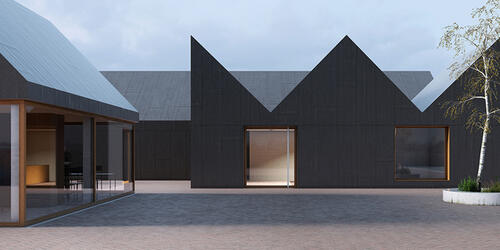
Cabourg Civic center - Thomas Bouchet - France
Cabourg, France
The project to create a new social and cultural hub for Cabourg combines two difrerent institutions: a community assistance centre and a multimedia library. The site for the project is nestled within a distended urban landscape comprised of residential sectors and public infrastructure. A pastiche of regional styles is the common thread running through the architecture of these surrounding elements.
The distinguishing feature of our proposal is the individualising approach to the two aspects of the project, housed in two distinct buildings facing each other. They are both designed as L-shaped structures, enclosing a clearly identifiable central courtyard, so as to set the site apart from its relatively unappealing immediate context. Their respective entrances, situated in the smallest built elements, are easy to identify. These two structures ably combine the dimensional parameters of the local urban planning scheme with a reinterpretation of the existing archetype.
The community assistance centre’s outside walls are entirely glazed on all sides of the structure. Its roof is divided into ten contrasting angular faces whose crests run perpendicular to the building. Its interior volume is structured by this roof design whose vertical projection creates divisions between the office areas aligned within a single, open space. Lastly, a central furniture concept structures and distributes space crosswise over the building’s entire length. Flush with the joists of the inside slopes, the roof gives the impression of being merely laid over them.
Conversely, the architectural concept for the multimedia library, with its monolithic approach, adopts a longitudinal crest style. The monumental interior volume is bisected by a central aisle and subdivided by the shelves, which create peripheral alcoves. The spacing between these shelves allows for large, square windows, with deep sills both inside and outside the building. The entrance facade identifies the site as a cultural institution, marking it out from its environment with a departure from the traditional double-pitch roof.